


Ceramic stones have become increasingly popular in recent years among both home decorators and professional interior designers. Thanks to their versatility, durability, and aesthetic appeal, ceramic surfaces are ideal for various spaces, including bathrooms, kitchens and other rooms. If you want to update your home with materials that are both beautiful and practical, ceramic is definitely worth considering.
Why choose ceramic stones?
Ceramic stands out for its unique properties. It is extremely durable, suitable for everyday use as well as high-traffic surfaces. In addition, ceramic stones offer a wide range of design possibilities, available in various colors and patterns. Whether you prefer a minimalist, rustic or more luxurious style, ceramic can find its place in your home. Ceramic surfaces help create a unique and harmonious interior while providing a practical solution that withstands daily wear and tear.
Main advantages of ceramic stones
Ceramic stones are known for their durability. They are scratch-resistant, making them ideal for bathroom countertops. In addition, ceramic is heat-resistant, which means that hot hair straighteners or other devices will not damage the surface.
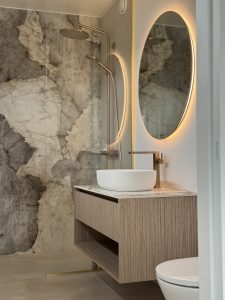
Another important advantage is their low liquid absorption. The ceramic surface is dense, preventing liquids and stains from penetrating. For this reason, ceramic materials are perfect for bathrooms, where surfaces are often exposed to water, makeup residues, and other liquids.
Ceramic is also easy to maintain. Regular cleaning requires only a damp cloth and standard cleaning products, making ceramic very convenient for everyday use.
Does ceramic have any drawbacks?
Although ceramic tiles are an excellent choice in many ways, it is important to consider some limitations. One drawback is the rigidity of ceramic. A strong, direct impact can cause the material to crack. For this reason, ceramic is not recommended in areas where there is a high risk of heavy objects falling. That is why we also do not recommend using ceramic for kitchen countertops.
In addition to rigidity, another limitation is the thickness of our ceramic tiles. We only sell 12mm thick ceramic, which means that when used in kitchens, there are several rules and standards that must be followed:
Cut-outs:
- No sharp 90-degree inside corners are allowed in cut-outs. All corners must have a minimum radius of R5, including notches.
- The distance between cut-outs and the edge of the slab, as well as between different cut-outs, must be at least 50 mm, except for tap and soap dispenser holes, which may be as close as 30 mm from the edge and sink cut-out.
- Only cooktops and sinks with a maximum edge thickness of 4 mm can be installed flush with the surface.
- Cut-out edges and sawn edges will have a different tone compared to the ceramic top surface.
Furniture requirements:
- The furniture must be perfectly level and stable.
- There must be full perimeter support under the ceramic surface.
- Cabinets should ideally have full tops. If the cabinets are wider than 600 mm, a full top is mandatory.
- There must be a gap of at least 2 mm between the ceramic and any wall or cabinet, which must be filled with silicone.
Worktops with turned-down edges:
- Minimum edge thickness is 32–34 mm.
- The worktop is reinforced from below with a Wedi board.
- The thickness of the turned-down leg must be 32–34 mm.
- For overhanging sections on islands, it is recommended to use a furniture board underneath. If stone is used instead, the worktop must be 32–34 mm thick.
Not permitted:
- Unsupported overhangs wider than 250 mm (Caesarstone) or 150 mm (Keralini). A furniture board is recommended underneath for support.
- Removing mesh from the back of the ceramic slab beyond 300 mm. The back side of ceramic differs in tone from the top surface.
- Creating a countertop and windowsill from one single piece.
- Drilling dowel holes into the ceramic for sink mounting. The sink must be attached with silicone and supported from below using brackets fixed to the cabinets.
- Making L-shaped parts.
- Creating joints that are not supported by cabinet side walls. Additional supports on cabinet sides are recommended at joint areas.
In addition, the rigidity of ceramic surfaces can make them uncomfortable for some users who prefer softer and more flexible materials.
Ceramic stones in your home
Our selection includes a wide range of ceramic stones suitable for bathroom countertops as well as decorative wall and floor coverings. We offer a full service, from measuring the stone to installation, ensuring a high-quality and convenient solution for your home.
If you are considering using ceramic stones, feel free to contact us. Our specialists will help you find the solution that best fits your needs and provide advice on how to care for and use ceramic most effectively.
FREE CONSULTATION
Our specialists are ready to help find the perfect stone solution for your project.
Contact us!
 Phone:+372 53402733
 Email: [email protected]
Or fill out the form on the contact page to receive a quick and personalized offer.